The American Heritage Songs Project

#71 Take Me Out
to the Ballgame
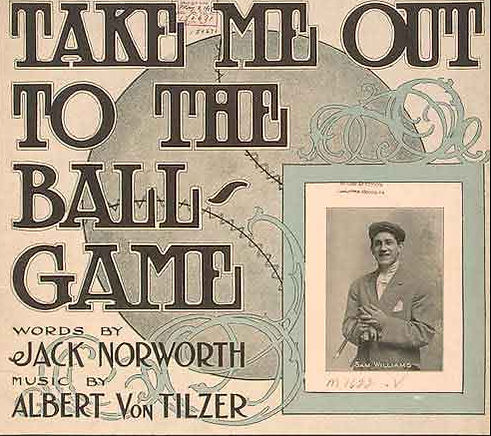
Few songs are more closely woven into the fabric of American life than “Take Me Out to the Ball Game.” For well over a century, its familiar chorus has echoed through ballparks from Little League fields to Major League stadiums, inviting generations of fans to share in one of our nation’s most cherished traditions. Yet while millions can sing every word of the chorus, surprisingly few know the remarkable story behind its creation.
Sheet Music & Lesson Plan
with additional resources
Sheet Music
Lesson Plan
Music and Lesson Plans coming. Perhaps you'd like to contribute?
Video: shows period images and provides 1908 performance of the song.
Myzeidi. (2008, August 13). Baseball "Take Me Out to The Ball Game" (1908) [Video]. YouTube. https://youtu.be/q4-gsdLSSQ0?si=j1Lt6u0SfSzIfsU6
Video: Famous ball players sing the song on the Ed Sullivan Show.
The Ed Sullivan Show. (2019, October 29). New York Yankees Stars Sing "Take Me Out to the Ball Game" on The Ed Sullivan Show. [Video]. YouTube. https://youtu.be/drOdOCuWNRY?si=ThAfEVO2CgGJHxAP
Sing Along Video
A Beautiful Day for Music. (2023, May 3). Take Me Out to the Ballgame (Lyrics) [Video]. YouTube. https://youtu.be/dQ1LWl5aPMY?si=FOKvci5xXN7YdeGK
Frank Sinatra & Gene Kelly sing Take Me Out to the Ballgame from their 1948 Movie of the same title.
Golden Hollywood Fan. (2018, September 12). Frank Sinatra and Gene Kelly - Take Me Out to the Ball Game [Video]. YouTube. https://youtu.be/-r2luDoV9TI?si=JeDSS-xwZ41RprJh
Song Background
Like so many enduring American songs, Take Me Out to the Ball Game began with a simple moment of inspiration.
In the spring of 1908, lyricist Jack Norworth was riding a New York City subway when an advertisement announcing a baseball game at the Polo Grounds caught his attention. Baseball was rapidly becoming America’s favorite spectator sport, and before Norworth reached his destination, he had begun writing the lyrics that would become one of the best-loved songs in American history. The melody was composed by Albert Von Tilzer, one of Tin Pan Alley’s most successful songwriters. Ironically, neither Norworth nor Von Tilzer is known to have attended a professional baseball game before creating what would become baseball’s enduring anthem.
The completed song was copyrighted on May 2, 1908, and published by the New York Music Company. It quickly became a popular vaudeville success as performers across the country introduced audiences to its lively melody and memorable chorus.
Most people know only that famous chorus, but the original song tells a delightful story.
Its heroine is Katie Casey, a spirited young woman whose love for baseball outweighs every other form of entertainment. When her beau invites her to a theatrical performance, Katie politely refuses. She would much rather spend the afternoon at the ballpark cheering for her favorite team. Once there, she proves herself to be no casual spectator. She knows the players, enthusiastically supports the home team, and even voices her opinion when the umpire misses a call. In an era when women were seldom portrayed as knowledgeable sports fans, Katie Casey emerged as an independent and confident character who delighted in America’s growing pastime.
Historians have long wondered whether Katie Casey was inspired by a real person. The Library of Congress notes that Trixie Friganza, one of America’s most celebrated vaudeville performers and a prominent advocate for women’s suffrage, was romantically involved with Jack Norworth during the period in which the song was written. Friganza appeared in two cameo portraits on early editions of the sheet music, and many historians believe her spirited personality may have influenced the creation of Katie Casey. Although no surviving document conclusively establishes that connection, the similarities are intriguing and offer another fascinating glimpse into the song’s history.
Although Take Me Out to the Ball Game became an immediate theatrical success, it did not instantly become a baseball tradition. For many years it remained one of the country’s favorite popular songs, performed primarily on the vaudeville stage. Gradually, however, fans began singing its familiar chorus during baseball games, and by the latter half of the twentieth century it had become firmly established as the traditional song of the seventh-inning stretch. Today it is difficult to imagine attending a baseball game without joining thousands of fellow fans in singing those familiar words.
The song’s growing popularity paralleled baseball’s own rise as America’s national pastime. On July 11, 1914, only six years after the song was published, a young nineteen-year-old pitcher named Babe Ruth made his Major League Baseball debut with the Boston Red Sox. Ruth would go on to become one of the greatest figures in baseball history, while Take Me Out to the Ball Game became the soundtrack of generations of American baseball fans. Together, they helped shape traditions that continue to unite families and communities more than a century later.
Perhaps that is why this song has endured for so long. It is not simply about baseball. It celebrates something even greater—the joy of sharing an experience with family and friends, the excitement of cheering for the home team, and the simple pleasures that have brought Americans together for generations. Whether sung in a neighborhood ballpark or before tens of thousands of fans in a Major League stadium, Take Me Out to the Ball Game continues to remind us that some traditions never grow old.
References
Library of Congress. (n.d.). Take Me Out to the Ball Game. Performing Arts Encyclopedia. https://www.loc.gov/item/ihas.200153239/
Library of Congress. (n.d.). “Take Me Out to the Ball Game.” In Baseball’s Greatest Hits: The Music of Our National Game. https://www.loc.gov/exhibits/baseballs-greatest-hits/take-me-out-the-ball-game.html
Library of Congress. (n.d.). Trixie, Jack, and Nora. In Baseball Americana. https://www.loc.gov/exhibitions/baseball-americana/about-this-exhibition/at-the-ballpark/the-ballpark-community/trixie-jack-and-nora/
entity[“organization”,“National Baseball Hall of Fame and Museum”,“Cooperstown, New York”]. (n.d.). Baseball’s greatest hit: “Take Me Out to the Ball Game.” https://baseballhall.org/discover/pop-ups/take-me-out-to-the-ballgame
Norworth, J., & Von Tilzer, A. (1908). Take me out to the ball game [Sheet music]. New York Music Company. https://www.loc.gov/item/2023796112/
Still popular in the 21st Century - Here is a symphony routing for their local team using the song!
Kansas City Symphony. (2014, October 23). Take Me Out to the Ballgame. [Video]. YouTube. https://youtu.be/laQt8b1li3o?si=fPIvZnVkk6WCV6Lz&t=36